


YOLO vs. Transformer-based Object Detection Model
YOLO has been the default for real-time object detection for years, but its CNN inductive bias and dependence on supervised pretraining are structural limits, not tuning problems. This guide breaks down where those limits surface, what transformer-based architectures with DINO backbones offer instead, and how to decide which approach fits your detection task.
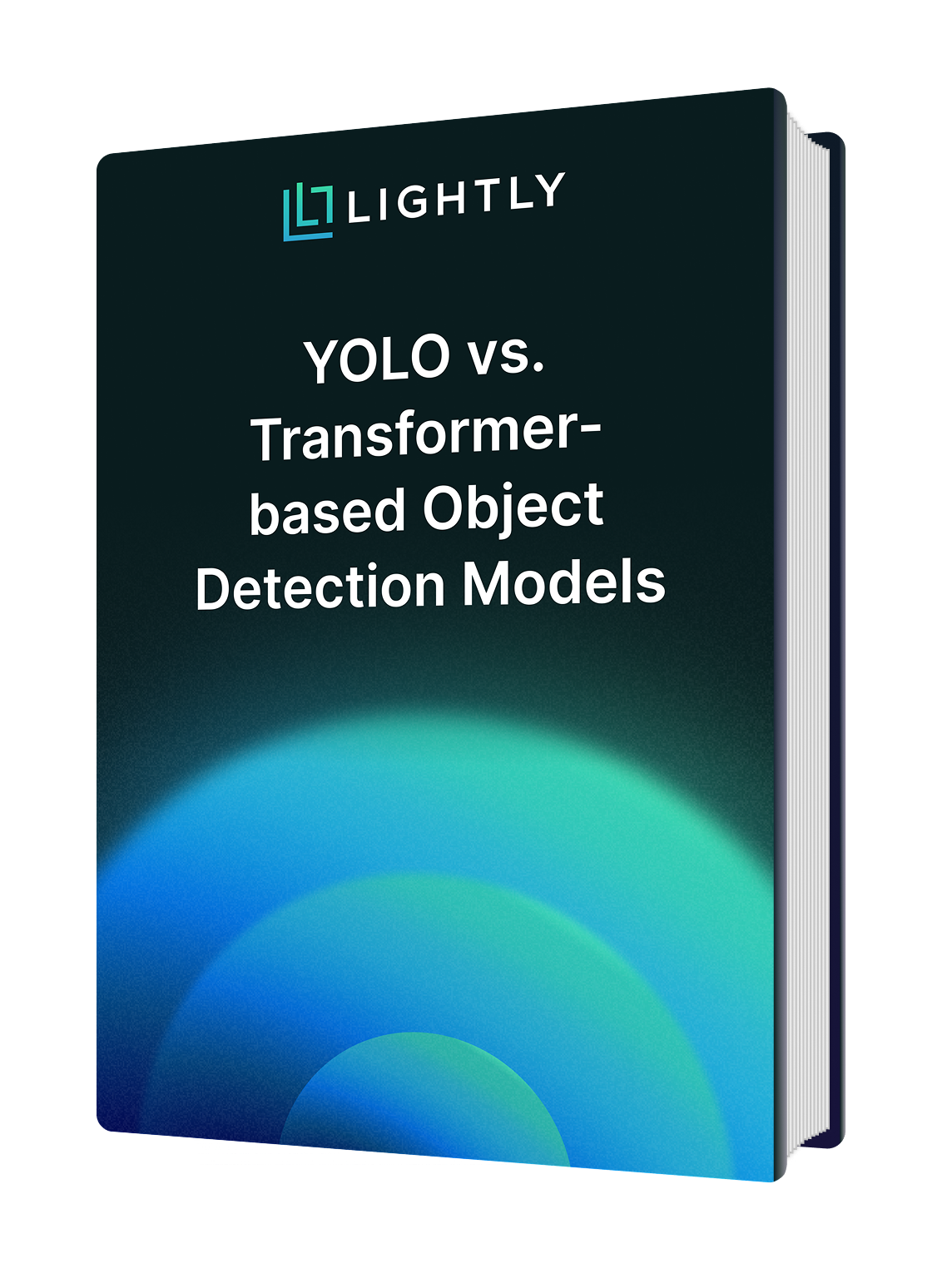
Gain insights into
YOLO vs. Transformer-based Models: A Side-by-Side Comparison
A structured breakdown of how YOLO and transformer-based detectors compare across seven dimensions: architecture, training, performance, dense scene handling, domain adaptation, inference speed, and deployment tooling. Covers where each approach has a genuine edge and where the tradeoffs actually show up in practice.
The Structural Limits of YOLO
YOLO's performance ceiling is not a data or tuning problem, it is architectural. This chapter explains the two root constraints: the CNN inductive bias that limits global scene reasoning on small, occluded, and densely packed objects, and the inability to leverage vision foundation models like DINOv2 and DINOv3 trained on billions of unlabeled images.
How Transformer-based Architectures Resolve YOLO's Constraints
Transformer-based architectures are not an incremental improvement over YOLO, they resolve both structural constraints at the architecture level. This chapter explains how global receptive fields via self-attention address scene-level reasoning limitations, and how compatibility with foundation models like DINOv3 unlocks strong detection performance with significantly less labeled data.
Which One Should You Use: A Practical Decision Framework
The right choice depends on your latency constraints, scene complexity, dataset size, and deployment environment. This chapter provides a clear decision framework for choosing between YOLO and transformer-based detectors based on your specific requirements, and introduces LT-DETR as a practical starting point for teams moving to transformer-based detection with DINOv2 and DINOv3 backbones.
Explore Our Products
.svg)
LightlyStudio
Data Curation, Labeling & QA
Get data insights and find the perfect
selection strategy, label & QA data.


LightlyTrain
Self-Supervised Pretraining & Fine-Tuning
Leverage self-supervised learning to pretrain
and fine-tune models


You Are Invited: Join Lightly's Private ML Engineering Discord
Want in? Collaborate with 300+ ML engineers optimizing data for their AI models.
