


8 Best CVAT Alternatives for Computer Vision Teams in 2026
Table of contents
Share blog post



This guide compares the eight best CVAT alternatives for computer vision teams in 2026, covering open source tools and enterprise platforms across labeling, curation, and training workflows. It evaluates each tool's strengths, weaknesses, and ideal use cases — from multimodal generalists like Label Studio to 3D-focused platforms like Encord. Aimed at ML teams deciding whether to stick with CVAT or move to a more comprehensive data platform.

Share blog post
The eight strongest CVAT alternatives in 2026, from open source curation platforms to enterprise labeling tools — with a side-by-side comparison and a quick guide to picking the right one for your bottleneck.

8 Best CVAT Alternatives for Computer Vision Teams in 2026
CVAT is one of the most widely used open source annotation tools, with strong support for images, video, and 3D point clouds. It still does its core job well.
What's changed is the workflow around it. Modern computer vision teams need more than a labeling canvas — curation, embedding search, model-assisted labeling, and tight feedback loops with training have moved from nice-to-have to default. If CVAT is the only tool in your stack, you're probably stitching together exports, scripts, and dashboards to fill those gaps.
Below are the eight strongest CVAT alternatives in 2026, across open source and enterprise platforms. Jump to any of them:
CVAT alternatives at a glance
Here's how the eight tools compare on the dimensions that actually drive switching decisions — license, modality coverage, native curation, and how tightly each one integrates with training.
See Lightly in Action
Curate and label data, fine-tune foundation models — all in one platform.
Book a Demo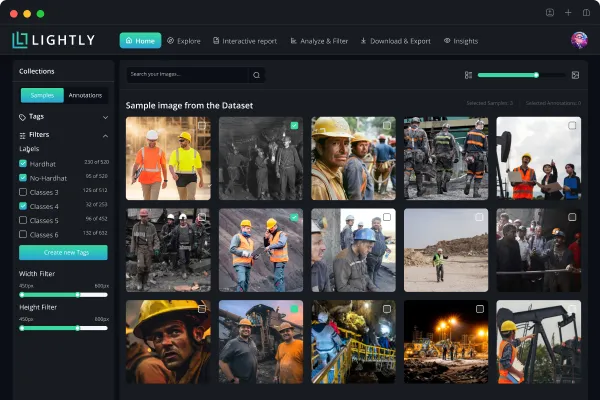
1. LightlyStudio — Curation, labeling, and embeddings in one platform
LightlyStudio is the open source data platform from Lightly, an ETH Zurich spin-off. It launched in autumn 2025 with a Rust backend and Python-first SDK, and is built around the idea that most annotation tools assume you already know what to label — when in practice that's the harder problem.
Best for: ML teams with large unlabeled datasets who want curation, embeddings, and labeling in the same tool.
Key features:
- Embedding-based search and filtering across image and video datasets (text and 3D point cloud support in progress)
- Curation built in: near-duplicate detection, edge-case discovery, data drift analysis
- Native image and video annotation with quality assurance workflows
- Active learning pipelines for selecting the most valuable samples to label
- Apache 2.0 open source, ISO 27001 certified, GDPR compliant
- Pairs with LightlyTrain for self-supervised pretraining on YOLO, RT-DETR, ViTs, and DINOv3
Where it falls short: The fully managed cloud version is still rolling out.
💡 Pro Tip: Pretraining on unlabeled data with LightlyTrain often cuts labeled data needs by ~50%. If you're going to invest in curation, pair it with pretraining — the two compound.
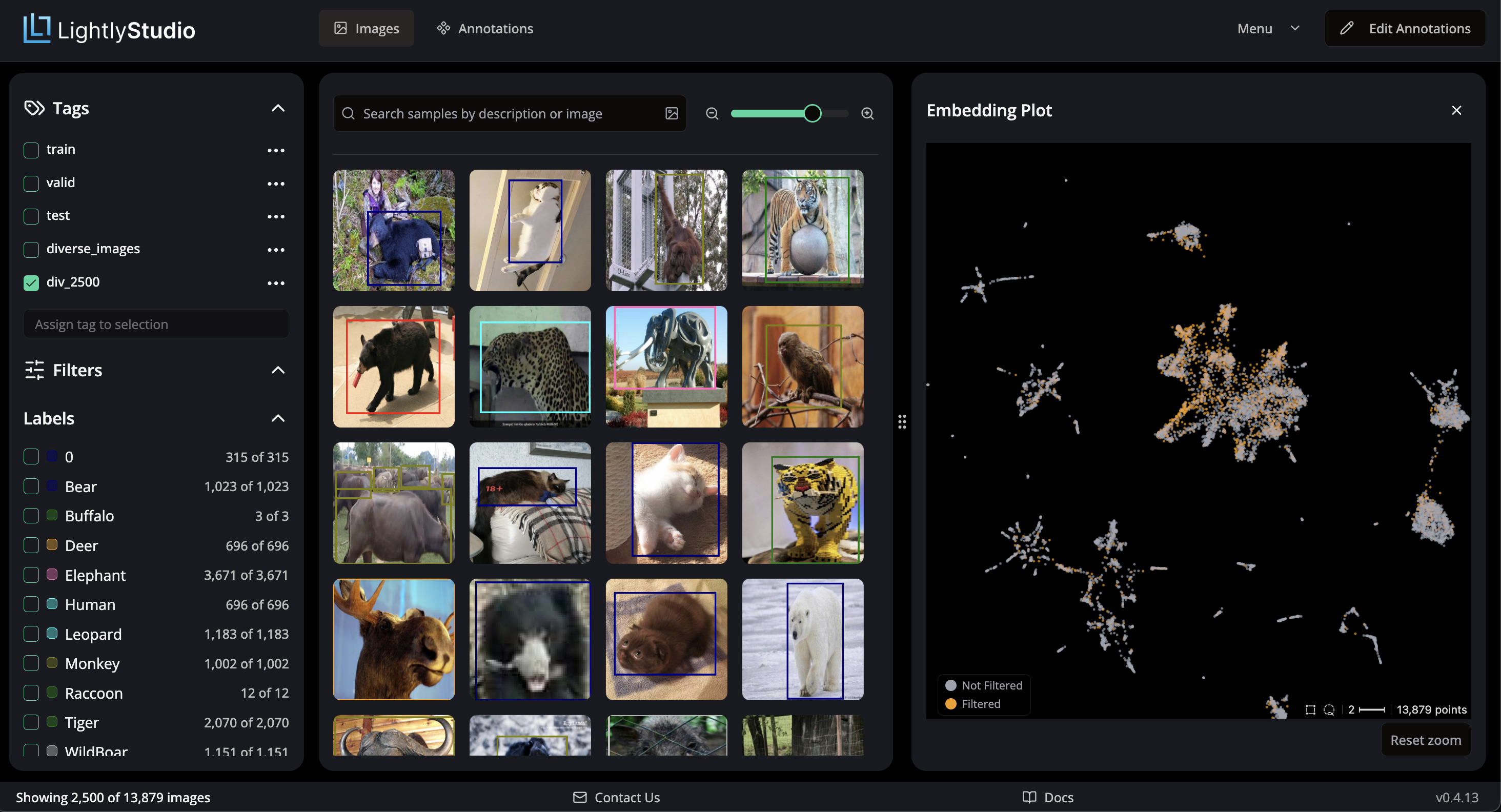
See how easy is to get started with LightlyStudio in just a few steps below:
2. Label Studio — Flexible open source generalist
Label Studio is an open-source annotation tool that handles text, image, audio, and video in the same interface. It's the go-to choice when your team labels more than just CV data.
Best for: Teams labeling multiple modalities, or NLP-heavy projects with a CV component.
Key features:
- Multi-modal labeling across all major data formats
- ML backend for model-assisted labeling and active learning
- Pre-built templates for common annotation tasks (bounding boxes, segmentation, OCR, medical)
- Free community edition; Label Studio Enterprise adds SSO, audit logs, and managed workflows
Where it falls short: XML-based labeling config has a learning curve. Self-hosting requires meaningful engineering effort.
💡 Pro Tip: If most of your data is CV and curation is the bottleneck, Label Studio's strength (multimodal breadth) becomes less of a fit. Compare it head-to-head with a CV-focused curation platform like LightlyStudio.

3. Roboflow — Developer-friendly end-to-end CV
Roboflow takes you from raw images to a deployed model in a single workflow. If you want to ship a working CV model this week, this is the shortest path.
Best for: Startups and individual developers who need fast time-to-deployment.
Key features:
- The shortest "raw images to working model" path in the space
- AI-assisted labeling powered by SAM and Grounding DINO
- Solid dataset management with versioning and augmentation
- Generous free tier
- Deployment to cloud, browser, and edge devices
Where it falls short: Less control than self-hosted options. The full platform is cloud-first, though Roboflow Inference offers self-hosted inference.
💡 Pro Tip: Roboflow optimizes for speed of deployment, not for dataset depth at scale. If you outgrow the cloud-first workflow and want pretraining + curation in your own infra, look at LightlyTrain alongside LightlyStudio.

See how easy pretraining and finetuning works inside LightlyTrain below:
4. Labelbox — Enterprise platform for large AI teams
Labelbox is built for organizations coordinating annotators, vendors, and AI models across many concurrent projects. It's the operations layer as much as the labeling tool.
Best for: Mid-to-large AI teams running multiple production annotation projects in parallel.
Key features:
- Multimodal: images, video, text, audio, PDF, geospatial tiled imagery
- Model Foundry — pre-labeling with frontier models (GPT, Claude, Gemini)
- Real-time collaboration, review queues, consensus scoring
- SOC 2 Type II, GDPR, HIPAA compliance
- Hybrid cloud connectors to Databricks, GCP, and Azure Blob Storage
- Optional Boost managed workforce
- Annotator-level analytics
Where it falls short: Enterprise pricing isn't designed for small teams.
💡 Pro Tip: Labelbox's strength is operational scale. If your bottleneck is choosing what to label rather than coordinating who labels it, a curation-first platform like LightlyStudio is a better starting point.
5. V7 Darwin — Automation-first labeling
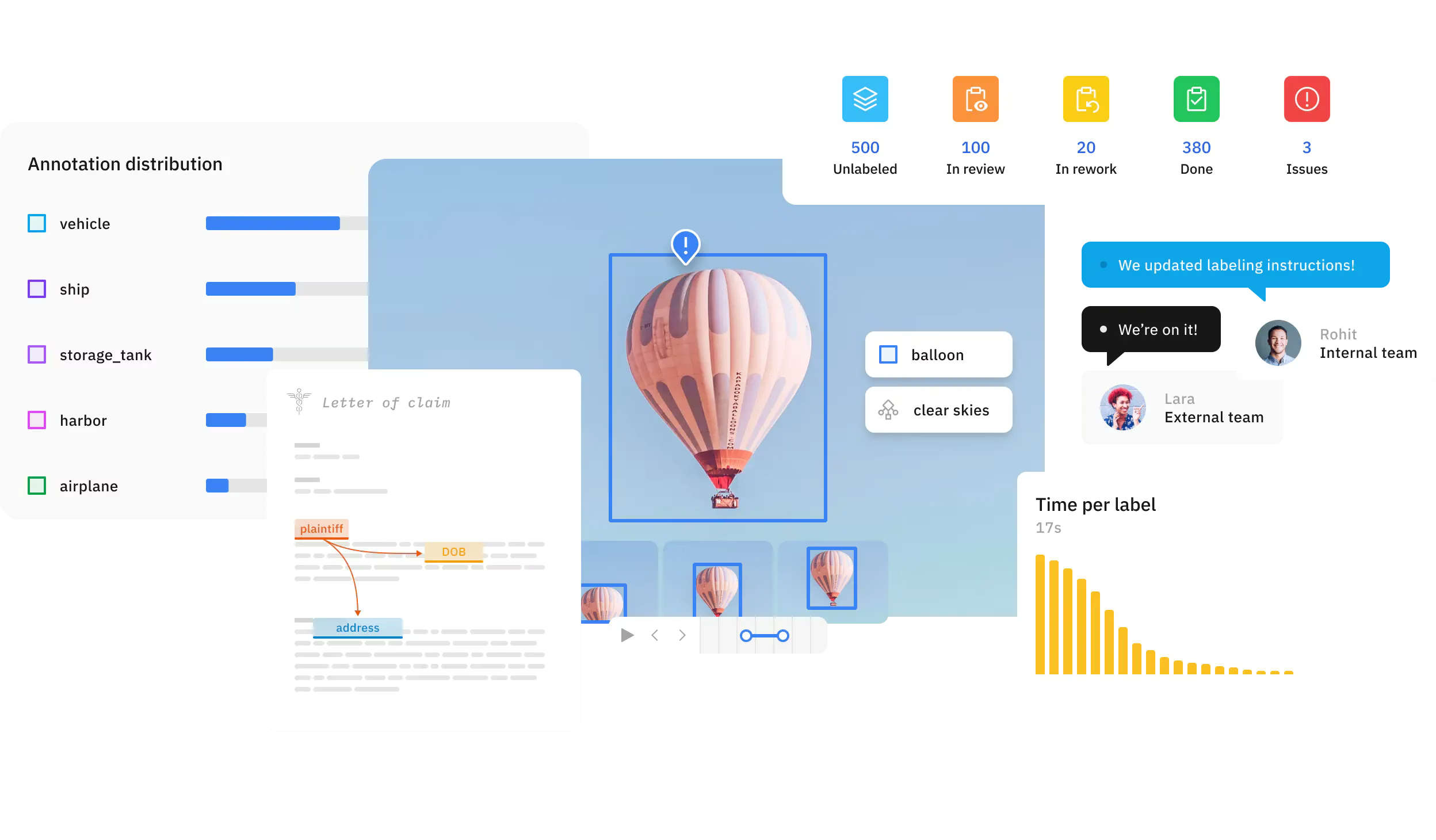
V7 Darwin has carved out a clear niche in medical imaging and high-fidelity video annotation, with strong DICOM support and auto-tracking across long video sequences.
Best for: Healthcare and life sciences teams where pixel-perfect segmentation on medical imaging is the core problem.
Key features:
- Native video rendering with object tracking across frames
- Auto-Annotate produces pixel-perfect polygon masks
- Strong DICOM support with multi-planar reconstruction
- SAM 3 integration for text-prompted detection
- SOC 2 and HIPAA compliance
Where it falls short: Quote-based pricing is steep for small teams.
💡 Pro Tip: If you're evaluating V7 against other medical/CV-focused platforms, see our deep-dive on Encord alternatives — many of the trade-offs apply: The 10 Best Encord Alternatives in 2026.

6. Encord — Data-centric platform for physical AI
Encord is a consolidated data platform with first-class support for LiDAR, 3D point cloud, and sensor fusion — the modalities that matter when you're building for the physical world.
Best for: Teams building autonomous vehicles, robotics, or drones where 3D and sensor fusion are core to the data.
Key features:
- Native LiDAR and 3D point cloud support with sensor fusion
- Encord Active for model evaluation and edge-case discovery
- Complex nested ontologies with dynamic attributes
- SAM 2 and SAM 3 integration for AI-assisted labeling
- SOC 2, HIPAA, GDPR compliant with audit trails
Where it falls short: Quote-based pricing is opaque. Onboarding is non-trivial.
💡 Pro Tip: Considering Encord but unsure if it fits? Read our full comparison: The 10 Best Encord Alternatives in 2026.

7. SuperAnnotate — Tool-first with managed workforce
SuperAnnotate pairs a polished annotation tool with an on-demand workforce marketplace — useful when you need labeling capacity without building a vendor management function.
Best for: Teams that want a polished tool plus optional outsourced annotation capacity in one contract.
Key features:
- Polished interface with strong AI-assisted labeling
- Managed workforce through the SuperAnnotate marketplace
- Solid 3D and video annotation support
- Extensive QA workflows and consensus scoring
Where it falls short: Custom pricing means limited transparency upfront.
💡 Pro Tip: SuperAnnotate optimizes for throughput on a defined labeling task. If you don't yet know which samples are worth labeling, start with curation in LightlyStudio first.

8. FiftyOne — Open source dataset curation
FiftyOne from Voxel51 is a dataset visualization and evaluation framework. It integrates with CVAT, Label Studio, Labelbox, and V7, so most teams pair it with a labeling tool rather than replacing one.
Best for: Engineering-led teams that want full programmatic control over dataset operations.
Key features:
- Best-in-class dataset visualization for images, video frames, and 3D
- Embedding visualizations to find near-duplicates and label mistakes
- Native model evaluation against ground truth
- Open source core with a paid Enterprise edition
Where it falls short: Not a labeling tool by itself — you'll still need one alongside it.
💡 Pro Tip: If you're choosing between FiftyOne and a unified curation + labeling platform, see our breakdown: The 10 Best Voxel51 Alternatives in 2026.

Honorable mentions
- Diffgram is an open-source data annotation and management platform designed for production-scale machine learning workflows, combining labeling, automation features, and data governance with custom workflows.
- MONAI Label is an open-source framework specifically designed for medical imaging workflows.
- LabelMe is an open-source tool that focuses on polygon annotation and is suitable for smaller projects and small scale projects in image labeling.
- Make Sense is a free, web-based, open-source tool that requires no installation and supports images and bounding boxes — allowing users to import datasets, label, and export annotations in minutes.
When to switch from CVAT
A few signals that you've outgrown CVAT alone:
- Curation matters more than labeling speed. With large datasets, picking the right samples beats labeling faster.
- You need multimodal data. Text, audio, geospatial, or tiled imagery alongside your images.
- Self-hosting is a tax. SSO, RBAC, audit logs, and uptime maintenance start to consume engineering time.
- You want labeling and training in one loop. Pre-labeling, evaluation, and re-labeling without exporting between tools.
Which AI models matter for annotation in 2026?
SAM 3 leads for concept-prompted image and video segmentation; SAM 2 and task-specific detectors still win on specific workflows. Grounding DINO and YOLO11 handle most object detection. MONAI Label is purpose-built for medical imaging. DINOv3 is currently one of the strongest vision foundation models, with state-of-the-art results across many settings without fine-tuning. Most modern annotation tools bundle several of these for AI-assisted labeling.
Who owns CVAT?
CVAT was originally developed by Intel and open-sourced in 2018. It's now owned by CVAT.ai Corporation, which operates CVAT Online, CVAT Community, and CVAT Enterprise.
How to choose the right CVAT alternative
Most teams don't need the "best" tool — they need the right one for their bottleneck. Map your situation to the list below:
- Bottleneck is choosing what to label → LightlyStudio or FiftyOne
- Bottleneck is labeling speed on CV → V7 Darwin or SuperAnnotate
- You're stitching too many tools together → Labelbox or Encord consolidate
- You label text/audio alongside CV → Label Studio, Labelbox, or LightlyStudio
- You need 3D, LiDAR, or sensor fusion → Encord
- You want raw images → deployed model fast → Roboflow
- You're in a regulated industry and need on-prem → CVAT Enterprise, LightlyStudio, V7, Encord, or Label Studio Enterprise
Whichever direction you go, the same rule applies: tool fit only shows up on your data. Run a one-week pilot on a real slice of your dataset before signing anything.
Final thoughts
CVAT is still a strong labeling tool. The reason this list exists is that the workflow around it has gotten more demanding — teams now need a data platform that covers curation, labeling, QA, evaluation, and a feedback loop with training.
If you spend more time figuring out what to label than actually labeling, LightlyStudio was built around exactly that problem, and pairs with LightlyTrain to cut label requirements through pretraining on unlabeled data.
Stay ahead in computer vision
Get exclusive insights, tips, and updates from the Lightly.ai team.

.png)
.png)